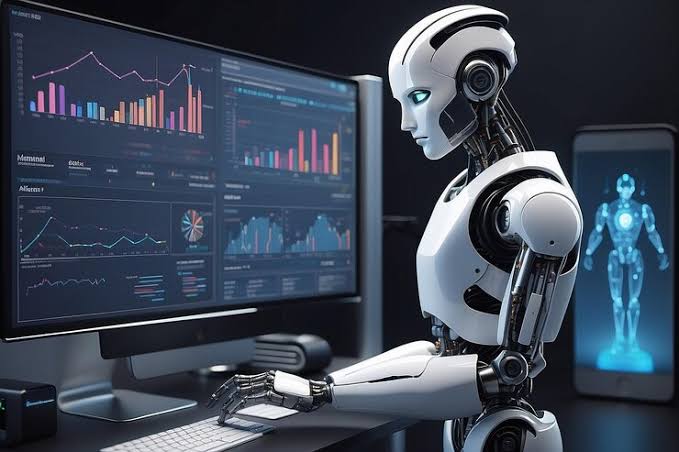
HIGHLIGHT
Ever wonder how your phone can recognize your face, a streaming service knows exactly what movie you’ll love next, or how a car can drive itself? The answer is artificial intelligence (AI).Far from being science fiction, or limited to just the chatbots we know and enjoy, AI is part of our daily lives in countless ways. It's one of the most transformative technologies of our time, acting as the engine behind modern innovation. But what does "Artificial Intelligence" actually mean?
SHORTBREAKDOWN:
Let's break AI down in a way that everyone can understand.What it is: AI is a field of computer science focused on creating smart machines that can perform tasks that typically require human intelligence, like learning, reasoning, and problem-solving.How it works: AI systems learn from vast amounts of data, identifying patterns to make predictions or decisions without being explicitly programmed for every scenario. Think of it as teaching a computer by showing it a million examples instead of writing a million rules.Where you see it: You're using AI every day in navigation apps like Google Maps, personalized recommendations on shopping sites, spam filters in your email, and virtual assistants like Gemini Live.Why it matters: AI helps us solve some of the world's toughest challenges—from accelerating medical research to creating more efficient supply chains and tackling climate change.
What is artificial intelligence (AI)?Artificial intelligence (AI) is a set of technologies that empowers computers to learn, reason, and perform a variety of advanced tasks in ways that used to require human intelligence, such as understanding language, analyzing data, and even providing helpful suggestions. It’s a transformational technology that can bring meaningful and positive change to people and societies and the world.It encompasses many different disciplines, including computer science, data analytics and statistics, hardware and software engineering, linguistics, neuroscience, and even philosophy and psychology. AI is about teaching computers to do the amazing things our own brains can do, from understanding the world around them to learning new things and even coming up with fresh ideas. For instance, AI is used in optical character recognition (OCR) to pull text and data from various images and documents. This process transforms unstructured content into structured, business-ready data, helping uncover valuable insights.
HISTORY OF AI
The idea of machines that can think for themselves isn't new. Concepts of artificial beings with intelligence stretch back decades, however, the modern field of AI truly began to take shape in the mid-20th century. Let’s take a look at the history of AI as we know it:The Seeds of AI (1940s-1950s): The invention of programmable computers in the 1940s sparked imaginations. In 1950, Alan Turing proposed the "Turing Test," a way to gauge if a machine could exhibit intelligent behavior indistinguishable from a human. This was a critical philosophical and scientific step.The Birth of a Field (1956): The Dartmouth Summer Research Project, organized by pioneers like John McCarthy, is widely considered the official birth of AI as an academic discipline. It was here that the term "artificial intelligence" was coined.Early Successes and Challenges (1960s-1970s): Researchers developed early AI programs, like ELIZA, a chatbot that could simulate conversations, and Shakey the Robot, one of the first robots to reason about its environment. However, the complexity of creating true intelligence led to periods of reduced funding and progress, often called "AI Winters."Revival and Growth (1980s-2000s): The development of expert systems and later, the rise of machine learning, breathed new life into AI research. Milestones like IBM's Deep Blue defeating a chess grandmaster in 1997 showcased AI's growing capabilities.The Modern AI Boom (2010s-Present): Advances in computing power, the availability of massive datasets, and breakthroughs in deep learning, especially with neural networks, have fueled the current AI revolution. This era has seen the emergence of powerful tools that are transforming industries.
Comments (0)
No comments yet. Be the first to share your thoughts!
Leave a Comment
Please login to comment and join the PI Network community discussion.
Create an Account